

Tax Appeal Commission Determination (58TACD2025): Impact on Pre-Sale Structuring
Holding Companies and Pre-Sale Structuring
When selling a business, holding companies sometimes form part of the sale structure. There are many reasons a holding company might be established – estate planning, group reorganisations, liability/asset protection, deal considerations, among others – but their broad effect on a sale from a tax perspective is that sales proceeds received in the company will usually be tax free.
This has advantages (i.e. the company will have more cash at its disposal post-sale) and disadvantages (shareholders do not have direct access to this cash) which will be weighed differently from case to case depending on the circumstances and commercial aims.
However a 2025 Tax Appeals Commission (TAC) determination has raised concern around the use of holding companies, particularly in the context of a sale.
TAC Determination (58TACD2025)
A holding company is typically put in place by swapping shares in one company (usually a business) for shares in the holding company. The person swapping their shares relies on a particular Capital Gains Tax (CGT) relief, to ensure no tax arises. TAC case 58TACD2025 looked at the use of this CGT relief in advance of a sale of a business.
The Facts
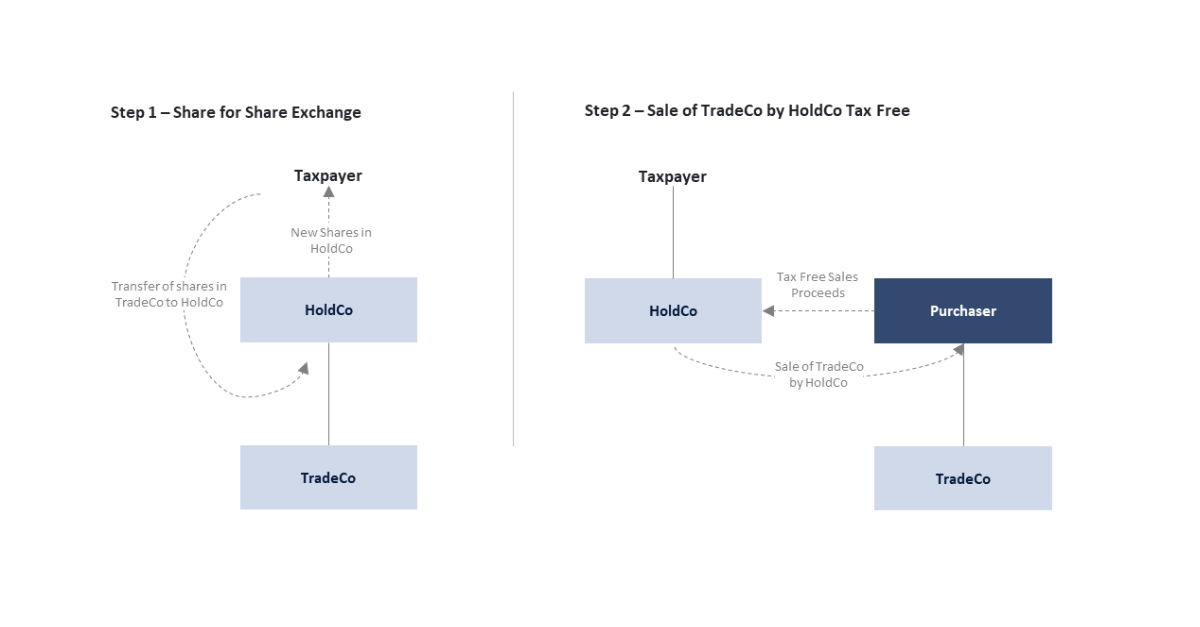
At a very high level, the case involved an individual who swapped shares in his trading company (“TradeCo”) for shares in a new personal holding company (“HoldCo”) shortly before HoldCo sold TradeCo to a third party. The steps were:
- June 20XX: HoldCo was set up with the individual as sole shareholder.
- 2 July 20XX: He transferred his shares in TradeCo to HoldCo. In exchange, he received additional HoldCo shares, and claimed CGT relief under Section 586 TCA 1997.
- 19 July 20XX: HoldCo sold TradeCo to a third party.
Because of the CGT rules, HoldCo got an uplifted base cost in its TradeCo shares, so the sale was essentially tax free.
Revenue’s Challenge
Revenue denied the CGT relief and assessed the taxpayer for around €350K. They argued that the paperwork did not meet certain technical requirements of the legislation. The TAC agreed.
But the more interesting part of the case concerned the anti-avoidance test under Section 586. To get CGT relief, the share for share exchange must:
- Be for genuine commercial reasons; and
- Not be part of a scheme mainly to avoid tax.
The taxpayer said the HoldCo was set up for succession planning and to separate personal and investment assets. The Commissioner was on balance convinced that the taxpayer satisfied the commercial test. However, they were not convinced that the arrangement was not tax-driven. It is the determination on this second point that is the most interesting and significant part of the case, and deserves closer attention.
The Taxpayer’s Argument
The taxpayer said he didn’t know about the sale of TradeCo at the time of the exchange, so tax avoidance couldn’t have been a motive.
This singular argument possibly overlooks some important points that could have been made in his defence. For one, the use of HoldCo achieved a deferral of the tax which would have arisen had he sold the shares personally – this may be distinguishable from avoidance (and has been in seminal UK cases on tax avoidance in share for share exchanges). While beyond the scope of this article, it is noteworthy that this point appears to have been uncontested.
The Commissioner’s View
The Commissioner agreed that if the taxpayer truly didn’t know about the sale until after the share exchange, then tax avoidance couldn’t be a purpose. It is not clear whether this follows as a rule, but in any event they said determining when he became aware of the sale was therefore key.
Once that became the focus, the outcome was inevitable. The evidence suggested the taxpayer likely knew about the sale at the time. As he didn’t present any alternative technical argument on the question of tax avoidance motive, the Commissioner could only rule against him, and found the pre-sale share swap was primarily tax driven.
Key Takeaways
In this case, knowledge of an impending sale was seen as significant by Revenue, the Commissioner, and even the taxpayer. But since this was not in any way challenged, we can’t know if Revenue will always infer tax avoidance on a pre-sale share for share exchange.
We would note that Revenue and the Commissioner also attached significance to the fact that the taxpayer had extracted cash from HoldCo post-sale by selling in property he owned personally which qualified for a separate CGT relief. We can’t say exactly how much this impacted the Commissioner’s determination.
As a result of this case, uncertainty now surrounds share for share exchanges as part of pre-sale structuring. The case has gone to the High Court, but since the taxpayer may be limited to the arguments already made, a clear outcome is unlikely.
What is clear is that share-for-share exchanges done shortly before a sale are likely to face more scrutiny. With this increased attention on share for share exchanges, we may see cases brought outside of a sale context as Revenue refine their position on tax avoidance in this area. This will probably deter taxpayers from using holding companies, and may even impact wider M&A activity for 2025 and 2026. Taxpayers who are considering the use of a holding company, regardless of context, should therefore be careful to take professional advice before doing so.